

"The Protégé" is an episode of the Alfred Hitchcock-executive produced TV series Suspicion, which ran for just over forty episodes between 1957-1958. This episode aired in May 1958 and starred Agnes Moorehead as actress Katherine Searles, Jack Klugman as stage manager turned playwright Jason Thomas and William Shatner as theater director Eli Jack.

The story in brief: Prima donna Searles has a profound problem with alcoholism. On the opening night of a major Broadway production, she ends up too drunk to perform and has to be replaced by her understudy. The incident all but ends her career.

Ten years later, Klugman's character Jason tracks Searles down to a summer theater near a cottage he's been renting fifty miles out of town.

He watches her performances during rehearsals, including her quarrels with theater director Eli Jack (Shatner).

Searles continues to struggle with self-doubt; her memories of being an alcoholic closely tied with her life as an actress. Despite the best advice of her friend, the young aspiring actress Pamela (Phyllis Love), she decides to pull out of even this amateur production.

Meanwhile, Jason meets Eli and offers him the directing reigns of a major new Broadway play he has written.

But there's just one other thing - he's decided he also wants Searles in the lead role. Searles? The alcoholic? The self-destructive troublemaker?
Despite her doubts, Searles gradually realizes that she is perfect for the role: that of a tormented suicidal mother. The actress vows to gives her all to the performance.
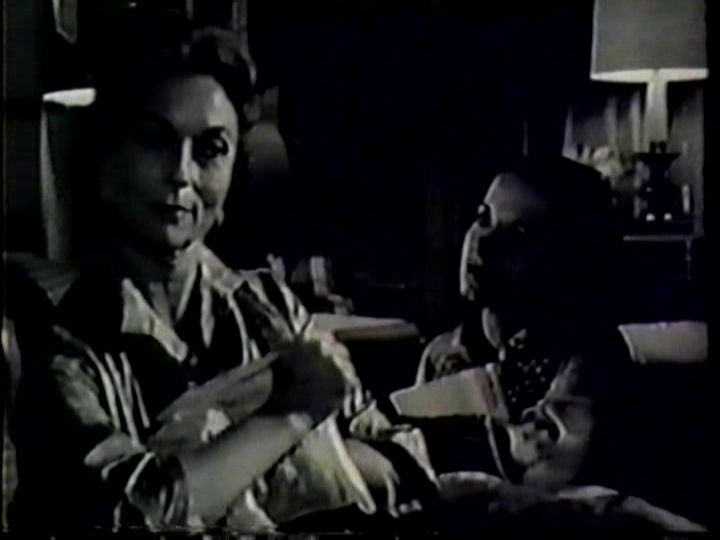
She insists that she won't let everybody down by returning to alcohol - besides, she has a trick for that, keeping a gun in her home which reminds her that she would rather die than have another drink.
Just as rehearsals for the new play ramp up and everything seems to be going wonderfully, Pamela, in true Poison Ivy or The Babysitter-style, tells Eli that Searles is drinking again - maybe she would be better for the starring role instead! The vixen even goes so far as to plant a bottle of drink in Searles' dressing room.

The promise of greatness quickly morphs into frustration and desperation. A repeat of what happened a decade ago would be utterly disastrous:
As a result of the accusations, Eli changes his plans for the play, readjusting it to accommodate young Pamela in the lead role.

Katherine Searles witnesses these secret rehearsals and is immediately devastated.

The false accusations morph into a retreat back into the dark reality from which she thought she had escaped - she begins to drink again.

Somehow, Searles manages to shake out of it and convinces both the writer and director to let her perform this role after all. But will the opening night be another disaster? Wait a minute - that's not a prop, that's the actress' real gun!

And that's where we'll leave it...

In the 21st century, sometimes the idea of having to watch old black & white TV dramas from the 1950s can seem like something of a chore - until one watches them. As with "The Defender" and "The Glass Eye", we were thoroughly enchanted, engrossed and enthralled by the earnestness (that's five words beginning with "e"!) of the drama on display. Back in those days, TV was still finding its feet as an offshoot of the theater - and these kinds of stories are eminently theatrical: tightly written, expertly performed and made with a level of dignity and craftsmanship that one rarely finds these days on the "boob tube".

Klugman-isms and Shatner-isms are on full display here (its fun to see the two actors interact)...

...although it's really Agnes Moorehead as actress Katherine Searles who steals the show as a diva trying to escape a prison of self-induced tragedy by returning to the (dangerous for her) world of acting. She has managed to stay sober for years, but she has done so at the expense of her career. Are the two inexorably linked? Can she break the cycle?

Let's move swiftly to the hair. We recently documented the two apparently very different toupological philosophies of Bill Shatner and Jack Klugman. Perhaps this is why Bill Shatner, despite appearing on nearly every other 1970s cop show during his "Lost Years" period, never appeared on Klugman's iconic Quincy M.E. Instead, Bill Shatner very publicly went curly in the style of a rival TV detective:
 Bill Shatner ultimately chose Peter Falk's hair over Klugman's retro-Kirk look.
There is one other element of this story that is particularly poignant. In real life, Bill Shatner's third wife Nerine was an alcoholic; it was a tragic addiction that would ultimately cost her her life. Ironically, it was recovering alcoholic Leonard Nimoy who tried to tell his friend the true import of what this meant. Bill Shatner writes in his autobiography:

Leonard recognized the symptoms immediately. The next day he called me and said, "Bill, you know she's an alcoholic?"
"Yes," I said "But I love her."
"You're in for a rough ride then."
I didn't understand what Leonard was saying to me. I didn't have the vocabulary. I was so certain that by loving her enough I could cure her...I tried to understand her addiction. If I said anything about it she would immediately become defensive, she'd respond by becoming furious with me. "I'm not drunk," she'd say in a slurred voice."What makes you think I'm drunk?"
 Nerine Kidd-Shatner (right).
The story depicted in "The Protégé" is ultimately a far happier one than that which Bill Shatner tragically experienced in real life. Yet, watching a young Bill Shatner act out scenes which would be eerily similar to his own life decades later (the emotional entanglement with another person's addiction; the fear that the alcoholic has broken their promise and returned to drink) is both moving and somewhat unsettling.
"The Protégé" is highly engaging entertainment and well worth watching. Sadly, it is not available to buy commercially, but was available to watch at the website museum.tv - although it appears to have disappeared from their archives! We'll keep you posted.


Katherine Searles witnesses these secret rehearsals and is immediately devastated.
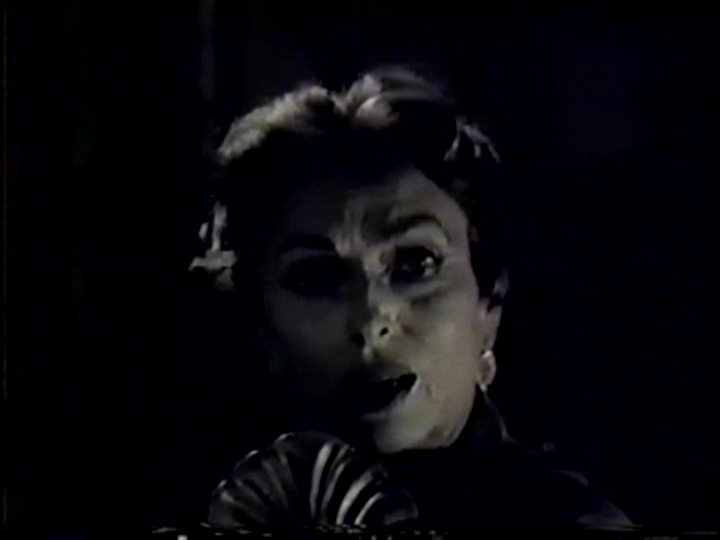
The false accusations morph into a retreat back into the dark reality from which she thought she had escaped - she begins to drink again.

Somehow, Searles manages to shake out of it and convinces both the writer and director to let her perform this role after all. But will the opening night be another disaster? Wait a minute - that's not a prop, that's the actress' real gun!

And that's where we'll leave it...

In the 21st century, sometimes the idea of having to watch old black & white TV dramas from the 1950s can seem like something of a chore - until one watches them. As with "The Defender" and "The Glass Eye", we were thoroughly enchanted, engrossed and enthralled by the earnestness (that's five words beginning with "e"!) of the drama on display. Back in those days, TV was still finding its feet as an offshoot of the theater - and these kinds of stories are eminently theatrical: tightly written, expertly performed and made with a level of dignity and craftsmanship that one rarely finds these days on the "boob tube".

Klugman-isms and Shatner-isms are on full display here (its fun to see the two actors interact)...

...although it's really Agnes Moorehead as actress Katherine Searles who steals the show as a diva trying to escape a prison of self-induced tragedy by returning to the (dangerous for her) world of acting. She has managed to stay sober for years, but she has done so at the expense of her career. Are the two inexorably linked? Can she break the cycle?

Let's move swiftly to the hair. We recently documented the two apparently very different toupological philosophies of Bill Shatner and Jack Klugman. Perhaps this is why Bill Shatner, despite appearing on nearly every other 1970s cop show during his "Lost Years" period, never appeared on Klugman's iconic Quincy M.E. Instead, Bill Shatner very publicly went curly in the style of a rival TV detective:
 Bill Shatner ultimately chose Peter Falk's hair over Klugman's retro-Kirk look.
"The Protégé" (interestingly this word has diacritics - essentially miniature hairpieces on top of letters - over its "e's" much like the word "toupée" has; though the accent-less "toupee" has become more common in recent times) is a very early example of Bill Shatner wearing his "Jim Kirk lace".

And though there are no toupological incidents to speak of, we wonder if this could this be the very first on-screen appearance of this iconic toupee. 1957's "The Defender" and "The Glass Eye" were still toup-less (see links above); "Playhouse 90: "A Town Has Turned to Dust" (from June 1958) shows Bill Shatner in a far more standard wig. However, appearances in The World of Suzie Wong had just been toupologically fortified with a piece very closely matching the "Jim Kirk lace". We can't definitively call it the very first on-screen appearance of this particular toupee as there are quite a few TV appearances from this time, which we have yet to analyze - but it is surely very close.


And though there are no toupological incidents to speak of, we wonder if this could this be the very first on-screen appearance of this iconic toupee. 1957's "The Defender" and "The Glass Eye" were still toup-less (see links above); "Playhouse 90: "A Town Has Turned to Dust" (from June 1958) shows Bill Shatner in a far more standard wig. However, appearances in The World of Suzie Wong had just been toupologically fortified with a piece very closely matching the "Jim Kirk lace". We can't definitively call it the very first on-screen appearance of this particular toupee as there are quite a few TV appearances from this time, which we have yet to analyze - but it is surely very close.


Leonard recognized the symptoms immediately. The next day he called me and said, "Bill, you know she's an alcoholic?"
"Yes," I said "But I love her."
"You're in for a rough ride then."
I didn't understand what Leonard was saying to me. I didn't have the vocabulary. I was so certain that by loving her enough I could cure her...I tried to understand her addiction. If I said anything about it she would immediately become defensive, she'd respond by becoming furious with me. "I'm not drunk," she'd say in a slurred voice."What makes you think I'm drunk?"
 Nerine Kidd-Shatner (right).
 The story depicted in "The Protégé" is ultimately a far happier one than that which Bill Shatner tragically experienced in real life. Yet, watching a young Bill Shatner act out scenes which would be eerily similar to his own life decades later (the emotional entanglement with another person's addiction; the fear that the alcoholic has broken their promise and returned to drink) is both moving and somewhat unsettling.
"The Protégé" is highly engaging entertainment and well worth watching. Sadly, it is not available to buy commercially, but was available to watch at the website museum.tv - although it appears to have disappeared from their archives! We'll keep you posted.





