Wednesday, December 7, 2011

Bill & Carrie & Leonard & Charlie.


Our previous post examined Bill Shatner's new-found liberation in using the word "hair". It appears that this abandon has now extended to the current and ongoing lighthearted "feud" (also see this vid) between the actor and actress Carrie Fisher over which franchise, Star Trek or Star Wars, was better.


Amidst the banter, Leonard Nimoy, alias Mr Spock, interjected and posted a tweet on his Twitter page arguing that: "Carrie Fisher says her hair buns in Star Wars are better than Spock['s] ears. I don't agree. Her hair can't hear. LLAP".


Interestingly, Bill Shatner then re-tweeted his former co-star's tweet on his own Twitter page before responding: "@TheRealNimoy I don't know about her hair buns but @CarrieFFisher's buns are better than Spock's ears. And they can hear better. MBB"


Clearly, Bill Shatner is a man who lies to take risks as he's skating on very thin lace here: Spock's ears, Leia's hair (we believe this iconic hairstyle was Fisher's own bunched hair at the very center of the buns, while the surrounding "donut ring" was likely a hair appliance) - does Bill Shatner really want to go there? Or is he cleverly veering away by shifting attention to Leia's other buns?

Apparently both Nimoy and Fisher are fully aware of the rules of the game and aren't about to take any obvious digs. Nimoy's ears, Fisher's hair buns or other buns - check, but Bill Shatner's hair becoming a part of this conversation, even though he's mentioned hair himself on Twitter, even though he once told George Lucas he was envious of his locks, even considering what he wrote in Shatner Rules - ain't gonna happen.

There are rules...

"There are a million things in this universe you can have and a million things you can't have. It's no fun facing that, but that's the way things are," Captain Kirk once said in the Star Trek episode "Charlie X". There are rules.


Thus, as tempted as Nimoy might be to joke to Shatner and Fisher: "Cinnamon buns or thick locks, at least I never claimed my ears were real! " or Fisher might be tempted to joke: "Bill, you're the odd one out, at least Leonard and I took our appliances off!" it just isn't likely to happen in a public forum.

It's clearly a sensitive subject, and if you wanna be Bill's pal, then roast and jest but let him and only him talk about his hair, or else...

Monday, November 28, 2011

Shatner Rules: an acoustical analysis.


As many of you will know, the William Shatner School of Toupological Studies houses some of the most advanced technology in the world, all designed provide humanity with the best possible insight into and analysis of William Shatner's toupee-wearing. Our most recent effort involves using state-of-the-art acoustic instrumentation on the audiobook version of Bill Shatner's latest tome Shatner Rules.

A toupular quantum resonance model.

Not long ago, we were delighted to report a rather direct hair reference by the author in said book.


That example, plus several others, form the core of the following report:

In one experiment, we amplified the sound of Bill Shatner saying the word "hair" to 194 decibels.

During the introduction of Shatner Rules, the author offers a perhaps crucial clue, "Bill is a slightly different guy from Shatner ... sometimes Shatner relaxes into Bill. Even Shatner can't keep up the Shatner all the time." Is this a subtle acknowledgement of the duality of wearing a toupee? Does the bald Bill Shatner become William Shatner by putting on his toupee in a Clark Kent/Superman sort of way?

Bill versus William? (Superman III)

A little while later, the actor jokingly describes actor Jason Alexander as a "bald, fat, has-been". Considering that Has Been was the name of Bill Shatner's 2004 album, is this code?


In Chapter 1, Bill Shatner illustrates his "always say yes" (is "yes" a coded response to the above or/as well as an answer to the final sentence of his previous autobiography?) rule by explaining how in 2006 he overcame reservations and agreed to partake in the Comedy Central Roast of William Shatner.

"If I spent more of my life saying 'no,' this autobiographical volume would be a slim one, indeed. But enough of the touchy feely stuff, let’s talk about . . . my scrotum. And my weight. And my hair. And my acting. And my weight. And my hair. Did I mention my acting?"


Here's the audio clip:


The roast continues and Bill Shatner, noting the hair jokes that flew his way during the show, notes:

"After a while all I could hear was 'Hair.' 'Acting.' 'Weight.' 'Singing.' 'Scrotum.' "

The audio:


A little while later, we get to "William Shatner Roast Insults & Rebuttals" and:

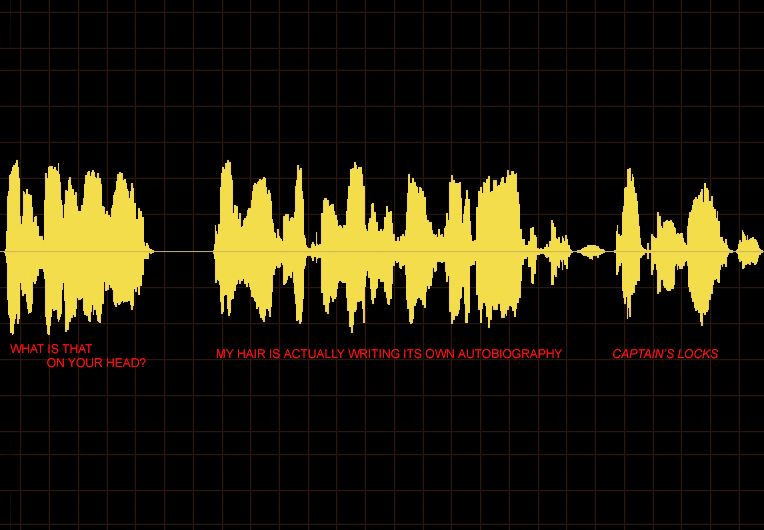
-"'What is that on your head?'

-My hair is actually writing its own autobiography, Captain’s Locks. I will reveal no spoilers in advance of publication."


The audio:


As if Bill Shatner has not said the word "hair" enough times in a single chapter (five so far and counting), we also get a couple more encores a little while later:

"After three hours—three long, agonizing hours—it was my turn at the microphone. I would get the final say after a long evening of me (and my horse) being drilled unmercifully about my acting, my hair, my weight, my acting, my hair, and my weight. And my scrotum."


The author then recounts his chance at an on-stage rebuttal:

"I would need a big opening, a huge joke, and one that announced that William Shatner is here, and he’s not going to take it anymore. So I opened with . . . 'How's the hair?'"

The audio:


And then :

"The Comedy Central Roast of William Shatner was one of that network’s highest rated programs, and it was eventually nominated for an Emmy for Outstanding Variety, Music, or Comedy Special. (We lost to a Tony Bennett concert special. I wonder how many jokes were made about his hair?) Most important, the show introduced me to many new young fans."

The audio:


And one more for good measure, this time a little more insightful:

"What I learned most of all from The Comedy Central Roast of William Shatner is that people have some very definite ideas and feelings about this William Shatner character. He’s larger than life, he’s omnipresent, he’s a narcissist, his acting and hair and singing talents are questionable at best, he’s a shill, he’s a comedy, he’s a tragedy, his scrotum sags with age, he speaks . . .very . . . strange . . . ly."


And one last piece of audio:


So that's nine mentions of the word "hair" in a single chapter (there's a couple more throughout the rest of the book too, including Hair the musical!). From utter silence on the subject to such willful abandon is surely an important step for Bill Shatner. He can finally say a word in public that has previously caused him a great deal of discomfort.

"The hills are alive with the sound of toupees!"

And as if seeking to make up for all those years of self-inflicted silence, he repeats that magic word over again and again and again! A stress analysis of the above audio reveals a far calmer and more assertive Bill Shatner than the one who a few years earlier nervously asked "do I wear a toupee?" While he still breezes over the word "hair" occasionally, no doubt seeking to prevent leaks of emotion, the word is nonetheless said loudly, directly and with a new-found sense of confidence.

It's been a delicate process, and one external nudge too many could again cause Bill Shatner to retreat.

But while we see some very important steps in the above, alas, we can't celebrate too much. As some of you noted in our previous post on Shatner Rules, while Bill Shatner uses the word "hair" liberally, even going so far as to note that it is writing its own biography and that "his acting acting and hair and singing talents are questionable at best," he avoids entirely the question of why.

"How's the hair?" Bill Shatner at the 2006 Comedy Central roast.

Thus, a reader or listener unfamiliar with toupological matters might be tempted merely to think that the actor has worn bad hairstyles or that his real hair looks like it's not real. But Bill Shatner never says that. He never says "my hair - which some claim is a toupee" or anything of the sort. It's very clever teasing in that it provides more than a nod to the initiated, but doesn't overtly signal too much to those not in the know!

Notice that Bill Shatner's head rests on the location of the Amazon rainforest. A subtle environmental message calling for protection and re-growth?

We can't wait till the next autobiography and where this extraordinary toupological journey will continue to lead us! The audiobook of Shatner Rules is available to buy. A fun, breezy book well worth reading (or listening to).

Saturday, November 19, 2011

Poll result and the "Denny Katz" gets a medal of distinction.


Our latest poll sought your views on the question of how Bill Shatner relates to the toupees he wears. Imagine that the time has come to retire one toupee and unwrap a fresh one. Is there a ceremony? Does Bill Shatner thank the old and welcome the new? "You did a great job!" and then "You and I are about to go on an incredible adventure!"... Or is it far less personal than that?

3% of you thought that the actor views his toups as little more than inanimate objects; 4% thought that he views them as members of the family; 7% saw a deep affection, like a close family member or pet; 14% suggested it was a love/hate relationship; 18% said it was a profound intimate connection, like with a lover. The most votes, 29%, went to "As protection, like children relate to security blankets".

Linus van Pelt from Peanuts.

Thanks for voting!

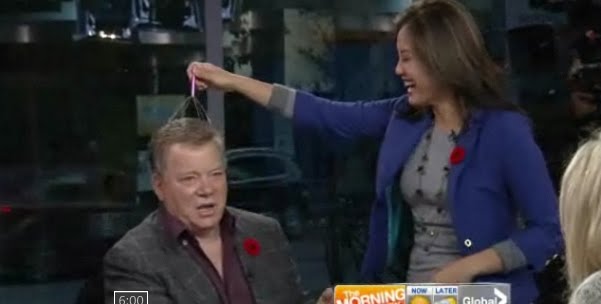
Now for the other thing. A recent appearance by Bill Shatner on Toronto's The Morning Show started off normally enough. But after some talk in which the actor notes that "we all hold a mask up" the conversation takes a rather interesting turn.


Suddenly, host Dave Gerry pulls out a head massager, asking "What's the significance of this object in your life?"


The actor seems not to know, calling it a "probe".

But, very much in a tone you'd expect from a combative political interview, Gerry intones "Mr Shatner..."


Is this an ambush?

The host then adds that according to his sources, Bill Shatner may have had box-loads of these things shipped from Canada to an "undisclosed location" in Europe where the actor was apparently attending a soiree back in 2010. Follicular regenerative therapy of some kind?


The actor cracks up.

And then, the unthinkable happens.


One of the female hosts (Kris Reyes) gets up...


...and begins massaging the head (and toupee) of Bill Shatner.


Is the toupee hair and membrane blocking out some of the strangely erotic "vibes" of this device? The actor seems to be getting it, though perhaps not with the full abandon that might be the case with his non-toup-wearing brethren.


Either way, what's really crucial here is: thank God this didn't happen years earlier when the actor wore a "TJ Curly" or "Lost Years" or even "Jim Kirk lace" as we may have been privy to a tangled, historic mess of epic proportions!


The "Denny Katz" performed with great distinction on this day and we extend our heartfelt congratulations! The full video can be watched in the second section here.

Friday, November 11, 2011

The dawning of the Age of Touperius.


It's April 1968 and the musical Hair has just opened on Broadway, underscoring a crucial component of the ever-growing hippie counter-culture movement of the time. Being with it wasn't just about politics, Vietnam, "Turn on, tune in and drop out", great music, expanding your consciousness etc. etc. - but many involved also viewed growing their hair long as a quintessential component of this anti-establishment movement - and that's what this musical sought to reflect.


Might a toupee have sufficed if the real thing was not in abundant supply? Who knows... But that's all besides the point. In 1968, Bill Shatner was evidently in no mood to Let the Sunshine In, feeling introspective rather than exuberant; morose rather than jovial. Star Trek was a flop, hanging on for dear life, and the idea that this series would one day be remembered as an unmistakable part of the Sixties, on the same lists along with the Beatles, the moon landing, Woodstock, RFK, MLK and all the rest of it would have seemed like so much pie in the sky had anyone suggested such a thing at the time.

Bill Shatner in character as Captain Kirk at a parade in South Carolina. More here.

And not only was Broadway housing such counter-cultural hair-related fodder, not only was Bill Shatner's starring show falling apart, not only was the archetypal leading man concept atrophying under such increasingly sterile and morally dubious titles as A Guide for the Married Man (New Hollywood would soon wash all of this away), but the actor's marriage to wife Gloria Rand was also all but over. Which brings us to a contemporary profile of Bill Shatner in a 1968 issue of TV Guide, via the good folks at "More Shat, Less Shame".


The piece (in the journalistic sense of the word) is characteristically upbeat about the star it is examining. There's the "Golden Boy" in the title as well as a flattering look at the actor's career.


But for Bill Shatner, "the dream [meaning the joy of stardom] was hollow". His father's death, the breakup of his marriage (played out in many a magazine of the time), and ongoing career struggles lead the actor to note "Out of a great deal of personal sadness, I feel I'm able to see behind people's masks." Perhaps the toupee is being subtly inferred here: a man with his own mask wishing to learn about others. (Did that desire culminate years later in Shatner's Raw Nerve?).

The tell-tale hairpiece...

But if only that was the only toupological inference - subtle, nuanced... No, TV Guide underscores just how much times are a-changin'. Only two paragraphs into their profile we get something rather stunning: "At 37, and with only a tell-tale hairpiece marring his intergalactic Golden Boy image, Shatner doesn't look very different from the way he did in the early 1950's when he was labelled a theatrical Wunderkind."


So one of the most popular publications in America announces to the world that Bill Shatner wears a "tell-tale hairpiece". Yikes! What happened to the days when profiles were a little more respectful of concealing stars' foibles? What was happening to the world?


And what of the hair pictured in the similarly morose-looking photograph that accompanies the article? Is it one of the the little-seen personal "ratty-looking" toups? The lack of the characteristic "real" hairline suggests that it's not a "Jim Kirk lace". Could it be the toup from Perilous Voyage? Or is it really one of the actor's own? At this point, we just don't know...


But what the image perhaps suggests is that the new times were offering Bill Shatner more than just unwanted toupological TV Guide revelations after all - his real hair a little longer, and of course there's those rather bushy sideburns - he was about to get with it; the ashes of past defeat cast aside, he was about to become The Transformed Man and popular culture would never be the same again:

"Shouldn't that be hairpiece?"

Now the 60's could really take off! Humanity was about to enter the Age of Touperius!

Sunday, October 30, 2011

Star Trek: The Motion Picture - a toupological analysis.


Star Trek: The Motion Picture is the first Star Trek feature-film and was released in the US on December 7th 1979. The entire extended cast, from William Shatner as James T. Kirk all the way to Grace Lee Whitney as Janice Rand are reunited in this $45 million epic for the first time since the run of the original series in the late 1960s.


Normally at this point we try to give an overview of the plot of whatever movie or TV show we are examining. But since we assume that most, maybe even all of our readers are thoroughly familiar with ST:TMP, we're instead going to do something a little different. We will try to relay the story of the film only through the significant central character moments/stories/threads contained therein:


James T. Kirk is now a desk-bound admiral. Promotion has left him restless and bored (this is inferred rather than seen).

When news reaches him of a strange, destructive energy cloud detected out there in our galaxy, Admiral Kirk senses his opportunity. After a heated conversation with his boss (again, described but not actually seen), he seizes control of his old starship - the newly refitted Enterprise. Only he, the admiral maintains, is qualified to lead such a potentially dangerous mission.


Meanwhile, something is up with Spock. Living back on Vulcan, he suddenly eschews the attainment of a higher order of logic because he seems to be sensing something out there. Is he in contact with this cloud? Is it contacting him? Why?


Back in Earth orbit, Kirk muscles his way into the command of the Enterprise, elbowing the young Captain Decker out of the way.


But Kirk appears to be masking a mid-life crisis.

Is he placing his own egotistical sensibilities above his now rusty abilities as captain? His sense of inadequacy grows as we see that the Admiral struggles to even find his way around the new Enterprise.


Kirk, lonely and lost, summons one of his two close friends in the universe aboard the ship. Dr McCoy protests. "I need you," Kirk exclaims. McCoy senses something is wrong.


Now en route towards the cloud, our suspicions about Kirk's competence are confirmed by an incident that almost destroys the ship.


Thankfully, the ousted Decker overruled Kirk and prevented disaster.


In a brief confrontation, McCoy gives the admiral an earful, accusing him of "using this emergency to get the Enterprise back". Kirk really begins to wonder about whether he's in over his head.


As the mission continues, the crew is stunned to find Spock suddenly showing up. Did he just miss his estranged friends and want to join in on this mission or is there more to it than that?


The half-human, half-Vulcan science officer seems to be acting even more strangely than normal. Not even McCoy's barbs stir any hint of the old-style sparring.


Spock, seemingly sharing his own tormented duality with the entity, then sneaks off into the heart of the cloud, and is lucky to survive the ordeal.


Can he be trusted? Has he gone off the deep end? It's alive, he says.


Is Kirk ignoring the fact that Spock is basically possessed? McCoy steps in...


Spock, it seems, holds the key and Kirk knows it.

The point we've tried to illustrate with the above is that there are plenty of seeds of characterization sown throughout the movie, particularly in the first act, but none of them are really fully developed into a dramatic punch or coherent story arc. At the beginning, Kirk is out of sorts; Spock is potentially under the control of some alien entity and McCoy doesn't even want to be on this adventure. Plenty of threads for a decent drama, but it all, sadly, falls apart as the movie continues.


The Kirk in-over-his-head aspect just kind of evaporates with a premature nod to Decker during the second act. Spock the possessed goes the same way (some of these scenes were actually cut from the theatrical release and only seen later in home video versions).

The character elements described above should arguably have provided the core of the movie, balancing out the journey towards the mysterious V'ger cloud heading towards Earth. And there was one person, the third man in the triangle, Dr. "Bones" McCoy, through whom these fireworks should, we think, have played off.

DeForest Kelley.

Ultimately, no-one is more ill-served by this movie than the George Harrison of Star Trek - DeForest Kelley. It gets so bad that after a few scenes, his character (watch the movie and count) actually ends up repeatedly entering the bridge, gawking and exiting again. That's perhaps the greatest symbol of what's wrong with Star Trek: The Motion Picture - the human core, McCoy, is suddenly rendered silent and barely relevant.


"Hi, I'm DeForest Kelley. You may remember me from earlier in this movie."

There's nothing one longs for more in ST:TMP than a good "Damn it, Jim!" moment or three in the second and third acts. McCoy could have argued with Kirk about the admiral's apparent inability to see that he's (still) in over his head; he could have also argued with Kirk about his inability to ask real questions about Spock's behavior and trustworthiness ("Why is no-one asking if we should even trust this guy? What if that thing out there has taken Spock over? What if he's trying to get us killed?"); he could have reminded Kirk about the fact that Earth too is in real danger and the consequences of all of this are huge etc. etc.

And then maybe Kirk, alone in his quarters, feeling the pressure, could end up giving some sort of a moving personal log entry:


"Is McCoy right? Have I lost what I once had? Am I in over my head? Maybe I should have stayed at that desk after all..." - that sort of thing. (Compare this to the Kirk arc in the sequel The Wrath of Khan, when the captain realizes "I know nothing" after his early cowboy approach comes up short. At the beginning, he feels old - by the end he says "I feel young").

What ST:TMP arguably needed somewhere during the second half is something very much like this:


It could have been dramatic. It could have been moving. It would have woven threads together that were stretched across the movie. But it just isn't there. Instead, everyone just ends up staring out into space waiting for something to happen.

That's what the hypnotizing excess of special effects, and wonder, and glorious music by Jerry Goldsmith can't conceal no matter how hard the movie tries to pretend that it's some deep philosophical tone poem. And there is only one reason for this: bad writing.

Harold Livingstone and Gene Roddenberry (source).

Behind-the-scenes accounts of the making of ST:TMP published in countless books and magazines paint a picture of utter chaos. What began as a low-budget TV movie soon morphed
into a pilot for a proposed new series, Star Trek: Phase II, called "In Thy Image". This then ultimately became Star Trek: The Motion Picture. The script was re-written and re-written, and shooting actually began with only the first act fully completed. It shows.

Two men fought and fought and fought over competing re-writes:
Star Trek's creator Gene Roddenberry and co-producer Harold Livingston.

Harold Livingston and William Shatner on set (source).

The latter recalled:

"Around this time, Roddenberry and I really began to get at each other's throats...I just didn't think that Gene was a good writer. He, for his part, considered me a total interloper." (source)

And so two authors, at complete odds creatively, often ended up sending competing re-writes to the set. It was dysfunction of the highest order and it ended up almost paralyzing the production.


What was wrong? We suspect that after a less-than-fruitful "Lost Years" of his own, post-original series, Gene Roddenberry somehow sub-consciously came to despise the one creation that had brought him success. As a result, given an opportunity to return to Trek, he decided to change it to prove that he was still creatively capable (maybe turn it more into a humanistic 2001: A Space Odyssey). The dramatically redundant Decker and Ilia would have been permanent members aboard Phase II (they later became the equally dramatically redundant Riker and Troi aboard TNG).


Anything, it seems, but focus on what had made the original series so great: the triangle (Leonard Nimoy would have been replaced by a new Vulcan called Xon in Phase II - he was later persuaded to return for the movie).

And so, during the 1970s, Roddenberry the terrific re-writer of TOS simply lost it. Head in the clouds, he seemed to forget the basic principles of good drama. With director Robert Wise unwilling or unable to do a Nicholas Meyer and simply seize the script and re-write it himself, chaos prevailed. Why Roddenberry didn't bring in TOS producer and master of both production and storytelling efficiency Robert Justman is perhaps the greatest unanswered question of them all. Was it simply ego, wanting to go-it-alone? We suspect this was the case. "You broke my heart, Gene," Justman would later recall telling Roddenberry about the matter, "But Gene didn't respond. He couldn't," he opined. The pair would eventually heal their wounds and work together again briefly on The Next Generation.

Robert Justman (right) would arguably have brought some much-needed discipline to ST:TMP.

Other problems, stemming from this script chaos, plague TMP too. Given the rush to make the December 1979 release date, the editing process became a frantic rush. As a result, the released movie was, in places, "essentially a rough cut" conceded Robert Wise (source) years later. Not only is pacing often dreadfully slow (say the wormhole "action" scene), but in some cases we see odd editing choices too (ironic as Wise was the editor of the legendary Citizen Kane).

Odd editing choices.

According to one account, "[At the premiere] Wise was seen to cover his face during some scenes as he'd requested more time to edit and fine tune the film, but Paramount said there wasn't any time left." (source)

And Wise's direction is rather shaky too. At times commanding, at other times it seems like he's fallen asleep at the helm (for example in the below scene).


Many (including Bill Shatner, who in Up Till Now noted "Robert Wise was a wonderful director, just not for this film") have questioned whether this director's often clinically detached directorial style was simply the wrong choice for this movie. Perhaps they have a point.

Interestingly, one of the moments where, towards the end, the movie suddenly gains a pulse and momentarily feels more like a TOS episode, with Kirk bluffing his way through a tense situation, was conceived by none other than Bill Shatner. Both he and Nimoy gained script approval after the movie went over-schedule. As Nimoy recalled of the scene in question "I mean Kirk and Spock were just basically staring at a blue-screen at the mercy of this...thing for pages and pages...[Bill Shatner's idea] tightened that particular scene, made it less talky, more interesting..." (source).


Yet for all its many flaws, it's impossible to completely dismiss the movie. For Trekkers of the time, the build up to the release of Star Trek: The Motion Picture was a magical event in and of itself. A failed TV series, then conventions, then the Space Shuttle Enterprise...

"Anyone seen Shatner?"

...and finally the return of the beloved cast in a new live-action adventure. Magically geeky times indeed! The fervor that surrounded the release needed no manufactured hype - there really were thousands and thousands of people who simply could not wait until ST:TMP was released.

Eager Trekkies in 1979 (source).

Compared to today's often instantly forgettable and rather mind-numbing CGI effects (that said, we strongly applaud the subtle and inventive CGI approach used to add new F/X to the 2001 "Director's Edition" of ST:TMP, which were nothing like the jarringly "computery" effects injected into the later TOS remastered project), Star Trek: The Motion picture is something of a work of art, with particular credit due to director of special photographic effects Douglas Trumbull.

Those were the days...(source).

The beautiful model photography is a genuine feat of craftsmanship...


...and serves as a testament to a very special time in American cinema, the late 1970s, when guys with beards essentially made visual magic with spit and chewing gum in the newly revived science-fiction genre.

From this...

To this... The now, sadly, largely defunct art of model photography (source and more pictures here).

So one can't help but come away from Star Trek: The Motion Picture and think: thank goodness we had one Star Trek made in the 1970s; one Star Trek that was more about exploration than the militaristic adventurism of most of the 80s installments; one Star Trek with a budget and talent capable of making the Starship Enterprise feel grand and majestic both inside and out. It's a failed attempt at an epic, but at least it's an attempt. No other Star Trek movie tried what this one did. And that's largely why, we think, that despite its numerous flaws, ST:TMP still manages to hold a special place in many a heart...

Let's move swiftly to the hair...

Persis Khambatta has her head shaved for the role of Ilia - was Gene Roddenberry sending Bill Shatner a message by creating a new bald character in Star Trek?

So Star Trek: The Motion Picture is released and thousands of Star Trek fans end up saying the same thing: "It's different!" "It doesn't have the same feel as the classic series!" "Why did you change it?". Did Bill Shatner make a mistake with his new toupee style in a way that mirrors some of the dramatic shortcomings of TMP? Consider that long, drawn out scene early in the movie when Admiral Kirk surveys and surveys and surveys the Enterprise from every conceivable angle.


It might as well have been the other way round, with a miniature Enterprise flying around a giant head studying the intricacies of Bill Shatner's intricately redesigned and refitted toupee...


Majestic? Certainly. But right there, something of the spirit of the original series is missing. Sure TOS was low budget, but there was also something inherently awesome in watching the original "Jim Kirk lace" toupee get all disheveled during a hearty fight scene. That was surely part of Gene Roddenberry's vision too.


Toupological moments in TMP? No time for such things - too busy looking serious and staring at things:


Near the end of the movie, Kirk at least wears a gold tunic. Maybe as a kid you closed one eye, stuck you finger out to obscure from view the non-black collar in a rather desperate attempt to see the old Kirk. And then you thought (rather unfairly): "It's still not him. It's the hair, dammit! The hair has ruined this movie!"


What we have in TMP is a very subdued "TJ Curly" far less like the disheveled look in 1976's Columbo appearance (or in the subsequent Trek movies)...


It's a sort of patty, really.


A helmet (it changes somewhat throughout the movie). And judging from what you our readers have repeatedly told us, the look was more than displeasing, it was even downright traumatic! Suddenly, many of you thought: "Oh, my God! Shatner is wearing a toupee!!!"


Even toy-makers were confused.


All the while, traumatized children wept...

"Mummy, what happened to Kirk?"

So what should Bill Shatner have done? A return to the "Jim Kirk lace" would have probably made the actor resemble Quincy.

Jack Klugman as Quincy.

But there was, we think, a viable alternative. The lace-like, light, side-parted toupee that Bill Shatner had worn repeatedly throughout the 1970s.

In 1971:


In 1975:


And even in 1976:

Bill Shatner in Barbary Coast.

It would at least have been Kirk-esque, while also allowing for some growth and change to accommodate for the passing years and 1970s styles. We think that audiences would have accepted this. But it wasn't to be. Dylan went electric and Shatner went curly - that's just the way life is sometimes.


To be fair, and upon considerable reflection, maybe Bill Shatner did do the right thing after all. Perhaps sensing the new sets, the new uniforms, the sudden emphasis on special-effects rather than characters, the actor decided to make a definitive statement: This really isn't the old series. It never can be. That was then and this is now. If I go back to my old 60s toupee, then all of this will probably seem even weirder; even more different. At least this way, the memory of what was is protected by this one major change. At least now we definitively know that what we are doing is something new -- still boldly going where no man, where no hair, has gone before...


UPDATE: One additional toupological observation we couldn't resist underscoring. A montage of fake hair that really speaks for itself. There are many subtle reasons why Bill Shatner is the odd one out here!