Showing posts with label 1958. Show all posts

Tuesday, February 21, 2012

New early "Jim Kirk lace" image.


Not long ago, we undertook a full toupological analysis of a 1958 episode of the TV show Suspicion called "The Protégé". We had to rely on a pretty poor-quality copy, but nonetheless still found that this was very likely one of the earliest on-screen examples of Bill Shatner touping-up with a "Jim Kirk lace".


Now, thanks to a recent LA Times article covering Bill Shatner, we have a new and far clearer image from this episode. And its one that displays the "Jim Kirk lace" with considerably more clarity.

William Shatner with actress Phyllis Love in 1958.

The contours of the hair are pretty much identical to the "Jim Kirk" style (doesn't Bill Shatner look like a skinny Capt. Kirk?), which the actor wore right until the end of Star Trek in 1969. Although at the back, we can see that the toup "lid" isn't quite fully integrated into Bill Shatner's real hair as it should be. Early days...


At this point, we're pretty confident that Bill Shatner still had enough of his own hair to create a kind of heavily-sprayed shell.

The toup-less heavily-sprayed "shell" option from 1957.

But with each passing day, the thinning was getting more intense, particularly at the back, as noted by this 1957 press report stating "[William Shatner] had already ordered a toupee to camouflage a thinning spot in the cinnamon hair."

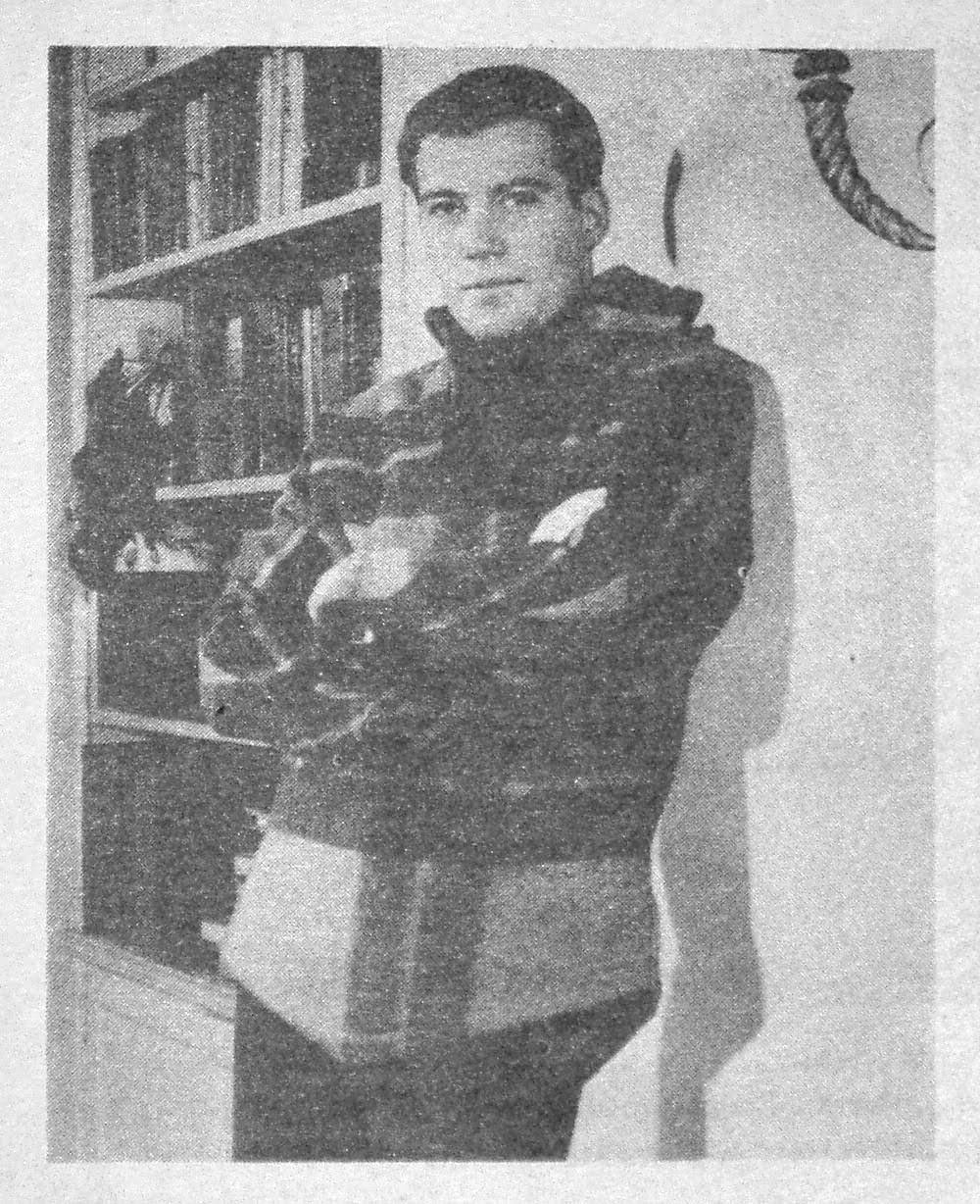
What we believe to be the last toup-less picture of Bill Shatner available to the public comes from a 1960 behind-the-scenes image of the making of "Mother, May I Go Out to Swim?". More on that here.

Bill Shatner, likely toup-less in 1960 - or is it 1959? (see update below).

Anyway, the new LA Times image is a very welcome addition to our archives. Here's hoping more recordings (and pictures) of Bill Shatner's 1950s TV work surface!

UPDATE: The above image may actually be from a 1959 TV show called "Tactic". See the NBC archives here. Thanks to reader Tintorera for the clarification.

Wednesday, June 8, 2011

Playhouse 90: "A Town Has Turned to Dust" - a toupological analysis.


"A Town Has Turned to Dust" is an episode of the 1950s television anthology series Playhouse 90 that aired on aired on June 19th 1958. Once again, William Shatner finds himself among illustrious company: legendary director John Frankenheimer is behind the camera for this installment, while The Twilight Zone's Rod Serling serves as its writer.

James Gregory

Hannify (James Gregory - a future guest-star in Star Trek), a reporter from the St. Louis Post-Dispatch, is in the small fictional southwest US border town of Dempseyville doing a story about life in the area. But instead, he finds himself at the center of a lynching. Dempseyville is gripped by an eternal drought and economic hardships; the community is a simmering cauldron of resentments - easy fodder for bitterness and demagogues like store-owner Jerry Paul (William Shatner).


Paul claims that a nineteen-year-old Mexican lad tried to violently rob his hardware store. The accused has been arrested, but the town sheriff (Rod Steiger) all but gives up his prisoner to the angry citizens of the town - a lynching mob - determined to carry out a far simpler and swifter form of justice.


The boy is then publicly hanged.


Celebrations, led by Paul, consume the town. For a while, Dempseyville's pent-up frustrations have been relieved - but only for a while.


Hannify refuses to toast the killing, informing the mob that he intends to write about the "whole thing". The cries of a small boy traumatized by witnessing the hanging ring through the bar. And that isn't all: the sheriff is in no mood to celebrate either, slowly consumed by the guilt of surrendering his prisoner.


He spills out his real feelings about the killing to the reporter: "We didn't know he was guilty - we just strung him up to satisfy the mood."


The sheriff's regrets explode in full public view as he further quashes the celebrations by recalling a previous and thoroughly brutal lynching that took place in the town sixteen years ago - that of an elderly migrant worker. Twenty men with hoods came and put him into a gunny sack, tied it to a horse-wagon and tortured the man to death.

As the funeral for the young victim takes place, Jerry Paul pretends to play nice with the Mexican community, but the dividing lines have been drawn.


The family of the lynched boy are distraught. There is a festering atmosphere in this place; a powder-keg of conflict and emotions.


Back with his wife, Jerry Paul reveals himself to be a tyrant at home too.

Paul literally putting the boot to his wife's face.

But there's more - a humiliating secret. The lynched Mexican was actually innocent of the crime of which he was accused. Instead, the contorted charges were retribution for Paul's frustrated, unloved wife having an affair with the man (see miscegenation).


Like the archetypal overcompensating villain, Paul then makes a show of proving that his store is friendly to the Mexican community.


But when they reject his superficial advances (he offers a boy some candy), he turns on them, publicly releasing a torrent of racist abuse and celebrating the segregation that keeps "muchachos" out of white bars.


The abuse leads to violence as Paul violently clashes with the lynched boy's bereaved brother.


Paul, brandishing a whip, ends up being beaten up by the man, who is then arrested.


Now, it seems, the brother is set to be lynched too...


But the sheriff has developed not just a conscience, but an inquisitive mind that threatens to unravel Paul's lies.


And he is also determined that under his watch, real justice will be done - and if the mob doesn't understand that, then they will be the ones in the firing line...


And that's where we'll leave the story...


So what to make of all this? Regular readers of this site and general Bill Shatner fans alike may no doubt think to themselves that all of this sounds awfully familiar. The echoes of Bill Shatner's infamous racist rabble-rouser Adam Cramer in The Intruder made just three year's later are unmistakable. As to which character, Cramer or Paul, is the bigger bastard, we'll leave that to you!

William Shatner in The Intruder (1962).

"A Town Has Turned to Dust" is precisely what it was intended to be: a powerful, hard-hitting drama. It's more atmosphere and tone than anything else (probably best watched more than once). The plot is simple, perhaps even a little ponderous, but the story of justice and moral force overcoming the mob mentality as told through the various characters is both powerful and involving.

John Frankenheimer fills the episode with some particularly creative shot compositions.

What's most remarkable is that it pulls no punches in its condemnation of racism as the result of scapegoats and straw-men and also economic hardships that lead to easy resentments of a comfortable "other". Complex stuff for TV.

Today, such a project would barely raise an eyebrow, but this was 1958, still six years before racial segregation, thanks to the Civil Rights Act, was to come to an end in the American South (Hispanics, though not treated the same way as blacks, were still considered "colored"). That this subject made its way into mainstream TV of the time is remarkable in and of itself.

Rope imagery...

A glowing contemporary New York Times review of the broadcast notes that Rod Serling "...made his point that hate for a fellow being leads only to the ultimate self-destruction of the bigoted. It was a theme that hardly can be restated amply enough and last night Mr. Serling expressed it with inspiration and fine determination."

Other superlatives in the review include "excellent" and "effective", while a young Bill Shatner also gets a mention too: "Mr. Shatner gave one of the best TV performances of his career. As the town bully and ringleader of the lynching party, he was the embodiment of hate and blind physical passion. Mr. Shatner's attention to detail in putting together the picture of an ignorant and evil social force was remarkable."


There are, we felt, some echoes in the story with Star Trek's "The Devil in the Dark" - the sheriff's 180 degree shift - towards the defense of the perceived aggressor - is rather reminiscent of Kirk's similar "The first man that fires is dead" ultimate defense of the Horta.

TV.com's entry for this broadcast notes that Rod Serling was disappointed and angered by the way his script was re-written prior to broadcast: "By the time the censors had gotten to it, my script had turned to dust. We're developing a new citizenry, one that will be very selective about cereals and automobiles, but won't be able to think." Nonetheless, despite whatever mollification of the material may have been undertaken by the censors, the punch is undoubtedly still there.


If there is one weak point, then it is an aspect of the cinematography. The short (wide-angle) lenses of the TV cameras used for this production mean that close-ups could only be attained by having performers literally centimeters away from the lenses (close enough to bump into them!).

Almost bumping into the camera!

At times, the framing and lighting forced upon the production by these lenses (and the necessities of a live production) leads to awkward results. Had the same actors, the same sets, the same director been given the time and opportunity of recording this project on film, with better lenses, some of this visual clunkiness could have been avoided. But it is a minor gripe...John Frankenheimer certainly does a fine job framing and staging the action.


Let's move swiftly to the hair...

Before our toupologists set about properly watching this episode, a number of them had previously seen a few snippets. Most were convinced that what they were seeing was an early, often shaggy-looking, toupee.


Upon further inspection, however, we believe that those initial impressions were dead wrong! "A Town Has Turned to Dust" is, we now strongly believe, a toup-less performance - one of the last. Let's try to explain. The aforementioned lens issue, means that we get some rather unusual close-ups of Bill Shatner's head:


What emerges, we believe, is a picture of a very carefully grown, combed and sprayed (lots and lots of hairspray) hairstyle, designed to create a thicker shell than would appear naturally.


At the rear, the unmistakable smooth arch of the "Jim Kirk lace" is absent.


Instead, we have careful combing concealing a bald patch at the rear. Occasionally, this bald patch peaks through just a little:


Sometimes the "shell" is disrupted, revealing its fragility:


While the "surely this is a rug" scenes (pictured below) are, we think, the result of flattening down hair that is absolutely loaded with hairspray, creating a kind of sticky, sweaty helmet:


Bill Shatner's hair is noticeably "unnatural-looking" in this episode, likely the result of this increasingly intricate procedure designed to bulk up his thinning locks. But when properly combed, it's remarkable how much the hairstyle resembles the "Jim Kirk lace" which at this period the actor was about to turn to full-time.


See here for a similar 1958 "shell" and here for a very early 1958 "Jim Kirk lace".


Asides from the above toupology, twice in this episode Bill Shatner picks up someone by the hair (underscoring the savagery of Paul's character). It's always remarkable to see Bill Shatner interacting with hair in any way - especially when one considers that pretty soon after this, the mechanics of his own toupee-wearing would have made a reverse scene (with someone pulling at Bill Shatner's "hair") all but impossible. Remarkable stuff, indeed...


And there you have it. A powerful piece of early TV - one well-worth watching. "A Town Has Turned to Dust" isn't available on DVD, but can be found online.

Sunday, February 6, 2011

Kraft Mystery Theater: "The Man Who Didn't Fly" - a toupological analysis.


"The Man Who Didn't Fly" is an episode of Kraft Mystery Theater, a long-running anthology series that ran on US TV under various permutations between 1947 and 1958. This episode aired in July 1958 and stars William Shatner, Patricia Bosworth, Walter Brook and Jonathan Harris (Dr. Zachary Smith of Lost in Space fame).

The hour-long pre-recorded episode (i.e. not performed live) is an adaptation of a 1955 novel of the same name by writer Margot Bennet.


The story (it's a little complicated, so bear with us) begins with a private plane traveling from Devon, south-west England to the city of Liverpool, crashing into the sea near Bristol. Three passengers are believed to have been on-board: self-declared young poet playboy Harry Walters (Shatner), entrepreneur Joe Ferguson (Harris) and wealthy artist Morgan Price (Milton Selzer).

Cor blimey, guv'na!

But a mechanic at the airport from which the trio took off turns up and is sure only two men boarded the flight. Inspector Jack Lewis (Brook) begins an investigation. Which of the men survived? Why hasn't the apparent survivor shown up anywhere?

Inspector Harris and former girlfriend Hester Wade.

The Inspector then interviews young Hester Wade (Bosworth), a former girlfriend of his - and now the fiancée of missing Harry. She's devastated at news of the crash, but desperately hopes that somehow her love of only one month was the one that made it.


We then go into flashback as Hester tells the story of how she first met Harry: he was a guest at the hotel owned by her father Charlie (Louis Hector).


Harry swept the young woman off her feet. This, despite their relationship meeting with strong disapproval from her father and most of the other hotel guests. Not surprising as his first introduction to the other guests went down like a lead balloon:


Enter Mrs Ferguson, wife of Joe. Artist? What a load of bull. The only artist that Harry is is a con-artist! How does she know? Because Harry had been blackmailing her!


But things are even more complicated! Neither Harry, nor the other two passengers seem to be all that they seem. Perhaps Ferguson is the conman or perhaps it is Morgan Price (whom Harry insinuates may have murdered his own mother to inherit her fortune).

The hotel staff and guests - from left to right: Morgan Price, Charlie Wade, Mrs Ferguson, Joe Ferguson and Hester Wade.

Hotel owner Charlie Wade insists on making an £850 investment in one of Ferguson's business schemes. Ferguson is hiring a private plane and flying to Liverpool to complete the transaction. Hester is concerned about a potential scam (by Ferguson) and so her father sends Harry along to make sure the investment is safe; also along for the ride is the mysterious Morgan Price.


So which of the three survived? Is there foul play afoot? Did someone steal all that money? Whodunit? That's where we'll leave it...


So what to make of all this? Despite the complicated plot, we found this to be a very neatly structured, rather engaging piece of drama. A great hook right from the outset and an unraveling mystery - the multiple points-of-view of Rashomon, the paranoia of Suspicion and just a twist of Dirty Rotten Scoundrels!

The three missing passengers.

The drama is set in England, with most of the American actors, including Bill Shatner, making only restrained efforts at creating convincing British accents. That part is a little odd, but overall we found "The Man Who Didn't Fly" to be pretty entertaining - no great emotional weight or huge drama, but certainly a decent execution on an undoubtedly intriguing idea.


Once again, in direct contrast to his later Shatner-esque staccato...dramatic...pause image, Bill Shatner gives a remarkably understated and restrained performance as a manipulative con-man. He's mean and deceitful, but also very charming, rather like the actor's performance as Adam Cramer in The Intruder (1961).

And Star Trek meeting Lost in Space (Bill Shatner and Jonathan Harris together on-screen) is something we'd never thought we'd see!

"Oh, the pain!" Kirk and Smith finally have it out!

Let's move swiftly to the hair...

There's only a couple of toupological moments in "The Man Who Didn't Fly" - the first being a rather indirect one at that - a joke about a bald actor losing his wig told by Inspector Lewis to Hester:


Also, during the blackmail scene with Mrs Ferguson (see clip above), Bill Shatner leans down and we see the light reflecting off his scalp.


But that isn't to say there isn't much of toupological interest here. Indeed, our team of toupologists confessed to having a very difficult time making a call as to whether Bill Shatner was or was not wearing a toupee in this appearance.


Was it real hair, heavily sprayed and thickened or was it an early "Jim Kirk lace"? Ultimately, we were forced to study several other Bill Shatner performances from this time...

1957's Studio One: "The Defender" we called as toup-less:


1958's Suspicion: "The Protégé" we called as wearing a toupee:


Even in 1958, we're sure Bill Shatner still had a relatively strong frontal hairline. The lace front toupee - when it was used - would have been placed on top of it, its "skin" glued onto the forehead. Doing this would have left Bill Shatner's real hair squashed by the toupee - evidence of which we find in a likely toup-less behind-the-scenes picture from 1960 (more here):


Incidentally, the above is the last, in terms of dates, toup-less picture of Bill Shatner we've managed to locate.

"The Committee for Toupological Evaluations" hard at work in the William Shatner School of Toupolgical Studies' "Situation Room".

An obvious question is: why use a front lace at all when you still have your own frontal hairline? Bill Shatner's balding started at the rear crown, with a bald patch evident as far back as 1956. He evidently began receding at the front in the early 1960s, but the hair atop was thin all round since the mid 1950s - especially under the heavy lights of a studio production. And that's likely the reason why: as the actor's hair was increasingly having to be sprayed and styled into a heavily bulked-up, fragile immovable shell. The toupee solved that problem pretty easily.

But back to "The Man Who Didn't Fly". The final 634 page report of the "The Committee for Toupological Evaluations" is equivocal in it's language, but leans heavily towards a conclusion that this is indeed a toup-less performance.


"The fragile, bulked-up nature of the hair leads us to conclude that this was likely a performance in which the front lace toupee was not used...several permutations of the lace were beginning to be used around this time, one of which was extremely light (''It was a lace hairpiece and he had less hair on it, so it looked more natural." source here) - it's possible that this is what we are seeing here, but upon consideration, we believe that this is unlikely."


Let's examine the evidence: The rounded front hairline appears far more in line with Bill Shatner's real hair than with the more pointed, heavy look of the toupee.

A likely toup-less picture from around the same time - notice the naturally curly hair.

By 1958, we have a look where the thinning is becoming increasingly evident...

Studio One: "No Deadly Medicine" (1958).

There's also this 1958 MGM publicity picture - the style is identical to that in "The Man Who Didn't Fly" Can spray do this much? We believe so:


It's a little confusing as the style in "The Man Who Didn't Fly" is so similar to the "Jim Kirk lace".

Definitely a front lace, but a very light one.

Let's look for clues at the back - the smooth, rounded "Jim Kirk lace" crescent appears absent - no toup?


Or is there evidence of a cap-piece, similar to that worn by Ted Danson in Cheers - clip here? It's possible. In some stills there is an unusual smoothness visible at the back of the head. Confused?


What we know is that in 1957, Bill Shatner began to grow his hair quite long at the top - this was then used to help create the illusion of bulk with careful styling. But the hair at the back was not always uniformly smoothly covered:

Fully toup-less in Studio One: "The Defender" (1957).

Evidence of a hitherto undocumented potential crown cap only phase can possibly be inferred from a picture of the play The World of Suzie Wong (more here), but it's something we haven't fully been able to confirm:


And of course the very same year, Bill Shatner (this time we're sure) wore a full lace in Suspicion: "The Protégé". So why one performance and not the other?

Notice the bulkiness of the hair at the front and the curvature at the back -it's a toup.

The style in "The Man Who Didn't Fly" so mimics the "Jim Kirk lace" one wonders (and marvels) at the planning that went into the transition from non-toup to toup - seamless!


In summary, we lean towards fully toup-less in "The Man Who Didn't Fly" but it took some painstaking comparison work and it wasn't at all an easy call to make! Let us know your thoughts!

"The Man Who Didn't Fly" is an entertaining little drama right from the heart of the Golden Age of TV drama. Certainly worth watching. Sadly, the show is unavailable commercially - it was up at museum.tv but can now only be found at online file sharing sites.